Duolingo Partners With Praggnanandhaa to Rebrand Chess as a Mainstream Sport
Duolingo India has partnered with teenage chess grandmaster Praggnanandhaa to reposition chess as a mainstream sport rather than an elite intellectual pursuit. The campaign aligns with Duolingo’s global expansion of its chess course, which treats chess as a logic-based language. By presenting Praggnanandhaa as confident, modern, and culturally rooted, the initiative reflects a broader shift in how learning platforms, sports culture, and youth identity intersect in India.
Chess has long occupied a unique position in India’s cultural landscape. It is respected, globally recognised, and deeply associated with intellectual excellence. Yet for decades, it has remained on the margins of mainstream sporting culture, perceived as serious, complex, and intimidating. That perception began to shift meaningfully in January 2026, when Duolingo India partnered with teenage chess grandmaster Rameshbabu Praggnanandhaa to reintroduce chess as a modern, aspirational sport for the digital generation.
The collaboration coincided with Duolingo’s global expansion of chess as a full-fledged course on its platform. More than a marketing initiative, the campaign represented a strategic attempt to reposition chess as a contemporary cultural pursuit rather than a niche intellectual hobby. By treating chess as a logic-based language and presenting Praggnanandhaa as confident, stylish, and commanding, Duolingo challenged long-standing stereotypes associated with the game.
At a time when India’s youth increasingly consume sports through digital platforms and social storytelling, the campaign reflects a broader shift in how education, sport, and popular culture intersect. Chess, once confined to elite circles, is now being reframed as accessible, engaging, and relevant to everyday life.
India’s Chess Evolution and the Shift Toward Mainstream Sport
India’s chess pedigree is globally admired, yet its mass adoption has historically lagged behind other sports. While the country has produced world champions and prodigies, chess was rarely positioned as entertainment or aspiration for the broader public. Participation often required formal training, specialised coaching, and a tolerance for a steep learning curve.
Over the last five years, this dynamic has changed significantly. A new generation of Indian players has emerged with global exposure, strong media presence, and cultural relatability. Online streaming platforms, mobile applications, and social media have made chess visible beyond traditional tournaments and classrooms.
India has also become one of the fastest-growing digital chess markets in the world. Mobile accessibility and vernacular content have lowered entry barriers, allowing casual learners to engage with the game without formal institutional backing. Chess today is increasingly consumed in short, interactive formats that prioritise learning through play.
Duolingo’s entry into this ecosystem reflects a clear understanding of these behavioural shifts. By positioning chess alongside language learning, the platform reframes the game as a skill that can be developed incrementally. This approach aligns with how young Indians already consume education, through daily practice, gamification, and measurable progress.
Praggnanandhaa and the New Face of Indian Chess
Praggnanandhaa represents a decisive break from the traditional image of a chess prodigy. Calm, composed, and globally competitive, he embodies excellence without intimidation. His rise has been marked not only by results but also by a quiet confidence that resonates with younger audiences.
By the start of 2026, Praggnanandhaa had firmly established himself among the world’s elite. His qualification for the FIDE Candidates Tournament 2026 followed a dominant run in the FIDE Circuit 2025, where he secured key victories at the Tata Steel Chess Tournament, the SuperBet Classic Romania, and the UzChess Cup.
These achievements placed him in serious contention for the World Championship cycle. However, what makes Praggnanandhaa particularly valuable to brands is his ability to connect beyond rankings and titles. He represents discipline without rigidity and ambition without distance.
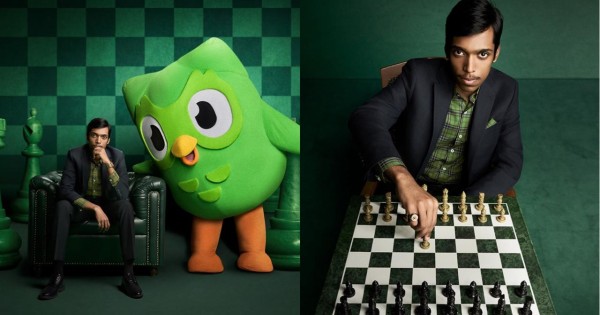
Duolingo’s decision to centre the campaign around him signals a conscious move to humanise chess. Rather than portraying him as a reclusive genius, the campaign presents him as assertive, fashionable, and culturally grounded. This reframing plays a crucial role in making chess feel approachable to first-time learners.
Duolingo’s Chess Course and the Language of Logic
Duolingo’s introduction of chess as a structured course marked a significant shift in how the platform defines learning. Chess was not treated as a casual add-on or a novelty feature. Instead, it was positioned as a logic language built on patterns, notation, and strategic fluency.
The course, launched globally in June 2025, breaks chess into modular lessons that mirror language acquisition. Learners progress through openings, tactical motifs, and board patterns using the same gamified framework that has driven Duolingo’s language success.
India quickly emerged as a key growth market. Millions of daily learners engaged with the chess course, validating the demand for low-pressure, habit-driven learning formats. In January 2026, Duolingo expanded the course to Android and introduced player-versus-player modes, further embedding chess within social and competitive digital behaviour.
By integrating chess into its core platform experience, Duolingo positioned the game as part of everyday learning rather than an isolated intellectual pursuit.
Campaign Execution and Cultural Messaging
The campaign film, conceptualised by Talented, was titled Bharat Got Blatant. The narrative deliberately moved away from reverence and formality, opting instead for confidence and cultural assertion.
Praggnanandhaa was styled in a modern interpretation of Madras checks, a visual nod to Tamil Nadu’s deep chess heritage. Billboards across Chennai featured this look alongside Duolingo’s mascot, creating a bridge between tradition and contemporary pop culture.
According to Karandeep Singh Kapany, Regional Marketing Director at Duolingo India, the objective was to make chess feel inviting rather than intimidating. Praggnanandhaa was chosen to represent a generation that is confident, aspirational, and relatable.
Conclusion
Duolingo’s collaboration with Praggnanandhaa marks a decisive moment in the cultural evolution of chess in India. By combining learning, sport, and contemporary identity, the platform has redefined how the game is perceived and accessed.
As chess continues its transition into the mainstream, initiatives like this will shape participation, engagement, and long-term growth.
Read more: www.entrepreneurnews.org